
The running speed is not just about dividing a distance by a time. This shortcut hides subtleties that change the planning of a training cycle: the gap between instantaneous pace and average pace, the reliability of the GPS signal, the link between speed and effort zones. Understanding these mechanisms allows for setting realistic goals and structuring sessions with precision.
GPS Bias and Instantaneous Speed: What Your Watch Doesn’t Calculate Correctly
Recent GPS watches automatically correct certain distance errors through algorithmic smoothing. In practice, the instantaneous speed displayed on the wrist fluctuates more than the actual speed, especially in dense urban environments or under forest cover.
This phenomenon has a direct consequence on training: GPS instantaneous speed is not a reliable indicator for regulating intervals. The latency time between actual acceleration and display update creates a delay that skews effort management over short intervals.
We recommend prioritizing the average pace per interval rather than instantaneous speed for any quality work. On the track, a manual stopwatch remains more accurate than a GPS for 200 or 400-meter repetitions. However, during long runs or easy jogs, the smoothed average speed over the kilometer becomes a relevant indicator, as micro-errors compensate over time.
For those who wish to calculate their running speed with Sportlinea, the approach using average pace over a known distance yields a much more usable result than a raw reading on the wrist.

Formula for Pace Calculation and Speed-Pace Conversion in Running
The basic formula remains simple: speed (km/h) = distance (km) / time (h). Pace, expressed in minutes per kilometer, is obtained by the inverse operation: total time in minutes divided by distance in kilometers.
The frequent confusion lies in the conversion between these two quantities. A speed of 12 km/h corresponds to a pace of 5 min/km. Converting from one to the other requires dividing by 60, not just flipping the numbers.
Quick Mental Conversion Method
To convert speed to pace without a calculator, divide 60 by the speed in km/h. At 10 km/h, the pace is 6 min/km. At 15 km/h, it drops to 4 min/km. This rule works both ways: divide 60 by the pace in min/km to find the speed.
Pace is the most useful indicator in training, as it directly corresponds to the perceived effort. Speed in km/h is more useful for comparisons between distances or for calculating split times in races.
Effort Zones and Speed: Linking Pace to Physiological Intensity
Calculating speed only makes sense if it is linked to an intensity of effort. Recent apps and watches increasingly guide runners towards paces by effort zone, not just towards a raw average pace.
The VMA (maximum aerobic speed) serves as a reference for calibrating these zones. Each type of session corresponds to a percentage of VMA:
- Fundamental endurance: around 65 to 75% of VMA, which is the pace at which one can hold a conversation. This is the foundation of the weekly training volume.
- Threshold pace: close to 80 to 85% of VMA, it corresponds to the pace that can be maintained in a half-marathon type race. Threshold training improves the ability to tolerate lactic acid.
- VMA pace: between 95 and 100% of VMA, used for short intervals (from a few hundred meters to a few minutes). This range develops maximum aerobic power.
A runner who trains only at average pace progresses more slowly than a runner who distributes their sessions among these three zones. The polarization of training (lots of slow volume, little fast volume, very little at moderate intensity) is the model that produces the best results in the long term.
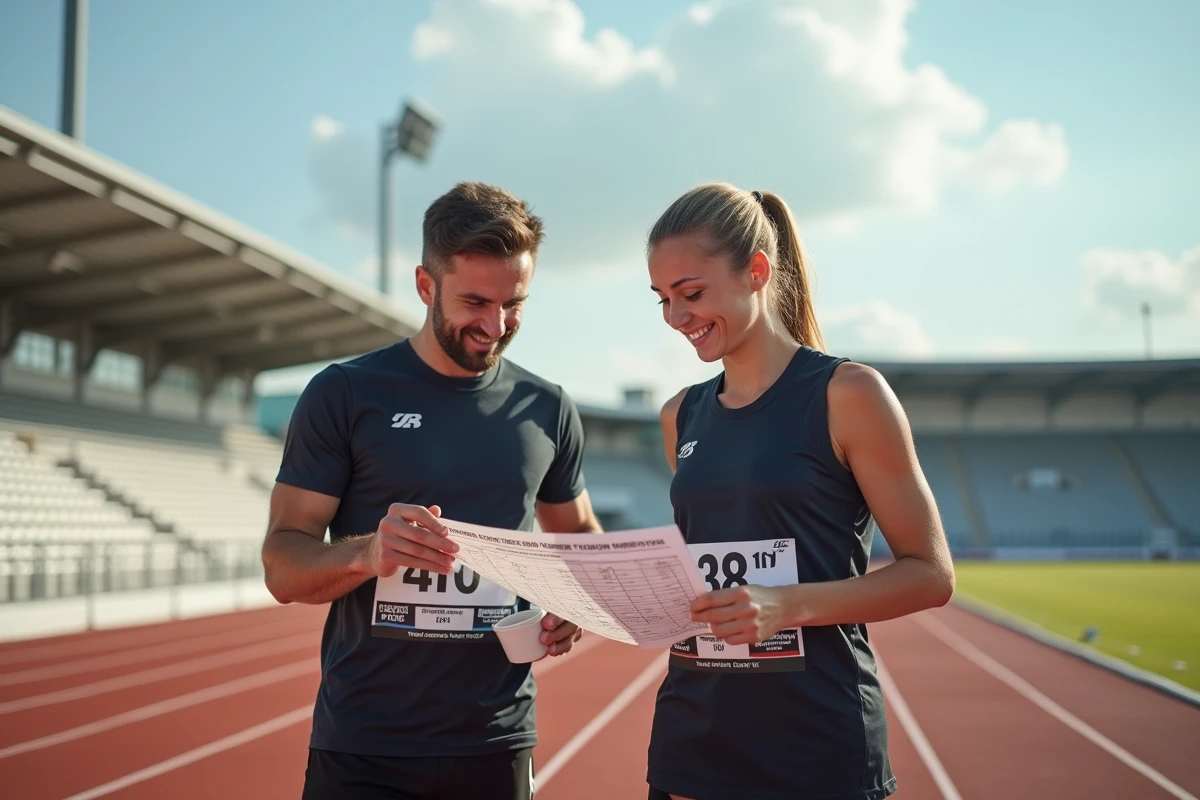
Estimating a Marathon or Half-Marathon Time Based on a 10 km Time
Performance prediction tables are based on a principle of progressive degradation of pace as distance increases. A runner who completes a 10 km at a certain pace will not maintain that rhythm over a marathon.
The margin of degradation varies according to the runner’s profile, but a common rule of thumb is to add a few seconds per kilometer at each distance tier. This estimation remains approximate: the level of fundamental endurance and weekly mileage influence degradation more than pure VMA.
Limits of Prediction Calculators
Online tools that extrapolate a marathon time from a 5 km time assume specific training for the target distance. Without this preparatory volume, the prediction overestimates actual capabilities. A runner who is fast over 10 km but lacks endurance on long runs will have a marathon time much slower than what the table suggests.
We regularly observe significant discrepancies between predicted time and actual time in runners who have not accumulated enough long runs at target pace. The calculator provides a theoretical potential, not a guarantee.
When and How to Recalculate Your Target Speed During a Training Cycle
The target paces defined at the beginning of preparation do not remain relevant throughout the entire duration of a plan. After four to six weeks of structured work, a field test (half-Cooper, VMA test over 6 minutes, or simply a time trial over 3 km) allows for updating the zones.
Recalculating your paces mid-cycle avoids two pitfalls: training too slowly if fitness improves, or pushing on intensities calibrated on an overestimated VMA. Both errors hinder progress.
The best time for this recalibration is after a block of aerobic development, before starting the specific work for the competition distance. A simple time trial over a short distance is enough to readjust the entire plan, provided it is done under standardized conditions (flat terrain, rest the day before, neutral weather conditions).
Running speed remains a tool for management, not an end in itself. A runner who knows how to measure it correctly, link it to their effort zones, and update it as they progress has a concrete lever to structure each week of training with minimal waste.