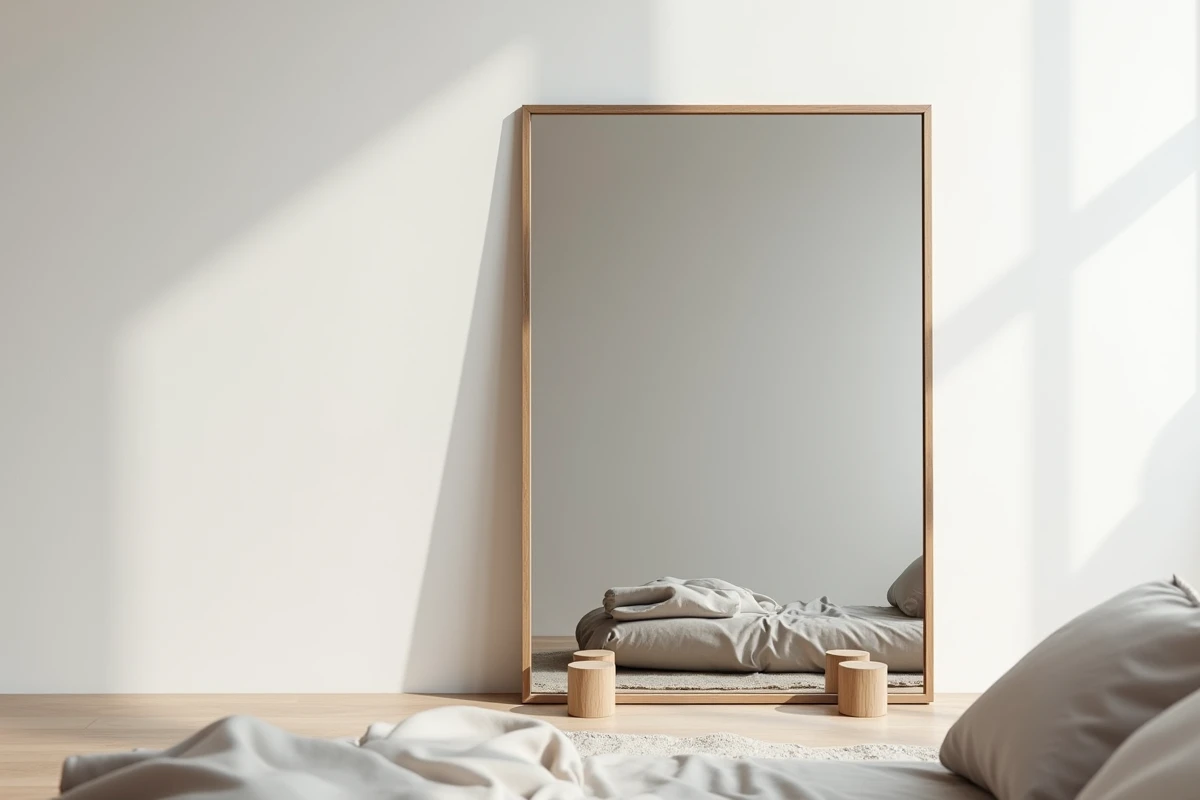
A full-length mirror leaning against a wall can slide, tip over, or scratch the floor. The challenge becomes even more complicated when the lease prohibits holes, when the wall is made of stone, or when the mirror is traveling in a camper van. Keeping a mirror upright without drilling or securing it to the floor relies on three parameters: the point of support on the ground, the angle of inclination, and the restraint against the wall or partition.
Anti-slip pads for mirrors: felt, silicone, or rubber
The first instinct is to place pads under the frame to prevent the mirror from sliding forward. The choice of material is more significant than it seems.
Felt pads, which are very common, work well on hardwood floors, cold tiles, and polished concrete. However, feedback from DIY professionals indicates premature wear of felt on heated floors, as the heat dries out the fiber and reduces adhesion within a few months. On this type of floor, soft silicone pads maintain their grip longer.
Rubber is suitable for smooth surfaces (ceramic tiles, vinyl), but it can leave black marks on light-colored floors. If you are looking for mirror support solutions for the floor suitable for each type of flooring, the choice of pad remains the foundation of any stable installation.
- Thick felt: ideal on non-heated hardwood, absorbs micro-vibrations, to be replaced approximately once a year.
- Soft silicone: withstands the heat of a heated floor, easy to clean, holds in place without sticking to the floor.
- Textured rubber: strong adhesion on smooth tiles, but should be tested in a discreet corner to ensure it doesn’t mark the surface.
Wall restraint strap: anti-tipping safety without drilling
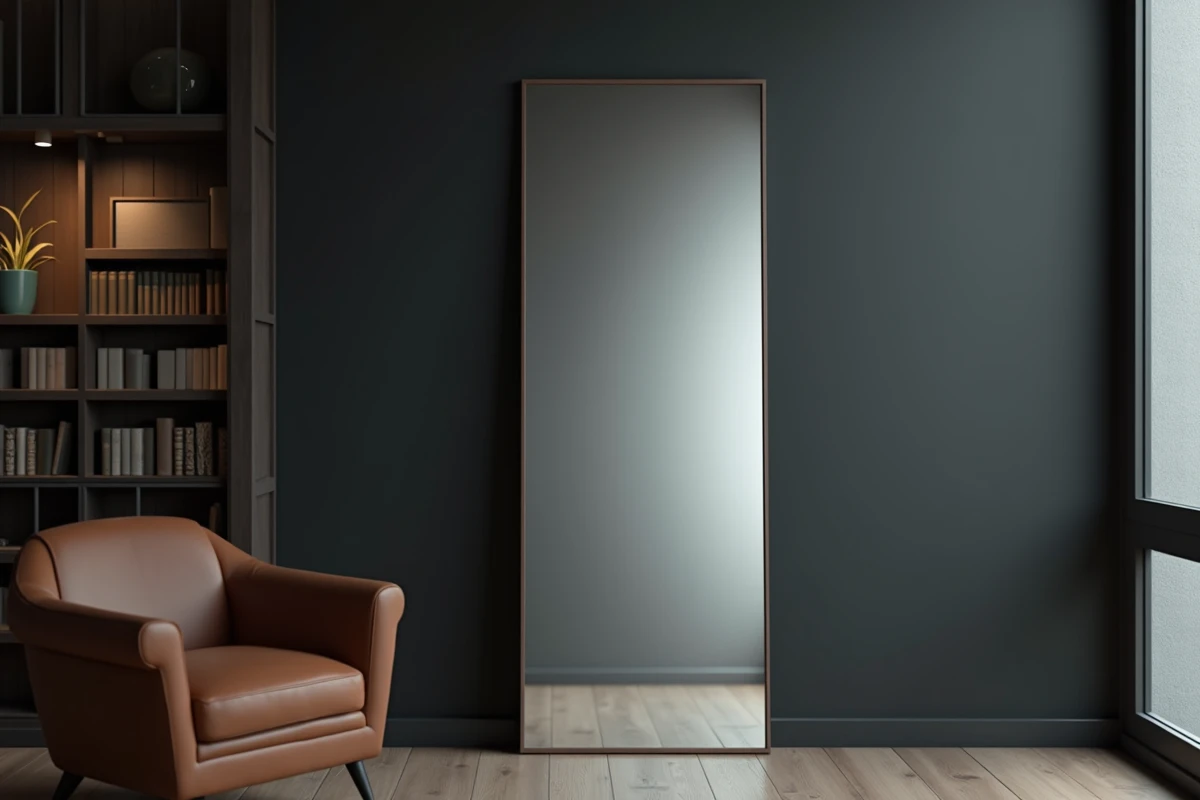
The pads prevent sliding, but not tipping. For a large mirror, a high restraint is necessary.
The simplest method: a textile strap attached to the back of the frame, connected to the wall by a strong adhesive hook. The hook is stuck to the partition at the height of the upper third of the mirror. The strap remains invisible behind the frame and catches the mirror in case of accidental push.
Nano-technology adhesives: an alternative to traditional hooks
Nano-technology adhesives that leave no residue have been gaining ground since 2025, especially in temporary rentals. They peel off cleanly, do not yellow like traditional glues, and can withstand enough tension to hold a tilted mirror. Their limit: on a plastered wall or a porous surface, adhesion decreases. A preliminary test on a hidden area is recommended.
Tilted mirror in a van or camper: stability in motion
This is probably the most demanding configuration. A mirror placed in a van experiences accelerations, braking, and constant vibrations. Apartment techniques are not sufficient.
The angle of inclination must be minimized, ideally between five and eight degrees. The more vertical the mirror, the less tipping force there is forward during sudden braking.
Low wedge and high restraint: the essential duo
On the ground, an L-shaped wedge (wood, aluminum, or custom 3D print) blocks the base of the frame against the wall of the van. The wedge should be screwed or glued to the vehicle’s floor, not to the mirror. At the top, a short strap or elastic tensioner connects the frame to a fixed anchor point on the body (mounting rail, existing hook).
The glass itself deserves attention. A tempered glass mirror or one coated with a shatterproof film limits risks in case of a sudden fall. An acrylic mirror, which is significantly lighter and impact-resistant, does not shatter, making it a relevant choice for any converted vehicle.
- L-shaped wedge fixed to the floor: prevents lateral and forward sliding during turns and braking.
- Short strap or hook tensioner: connects the top of the frame to the interior mounting rail of the van.
- Shatterproof film glued to the back of the mirror: retains fragments if the glass breaks anyway.
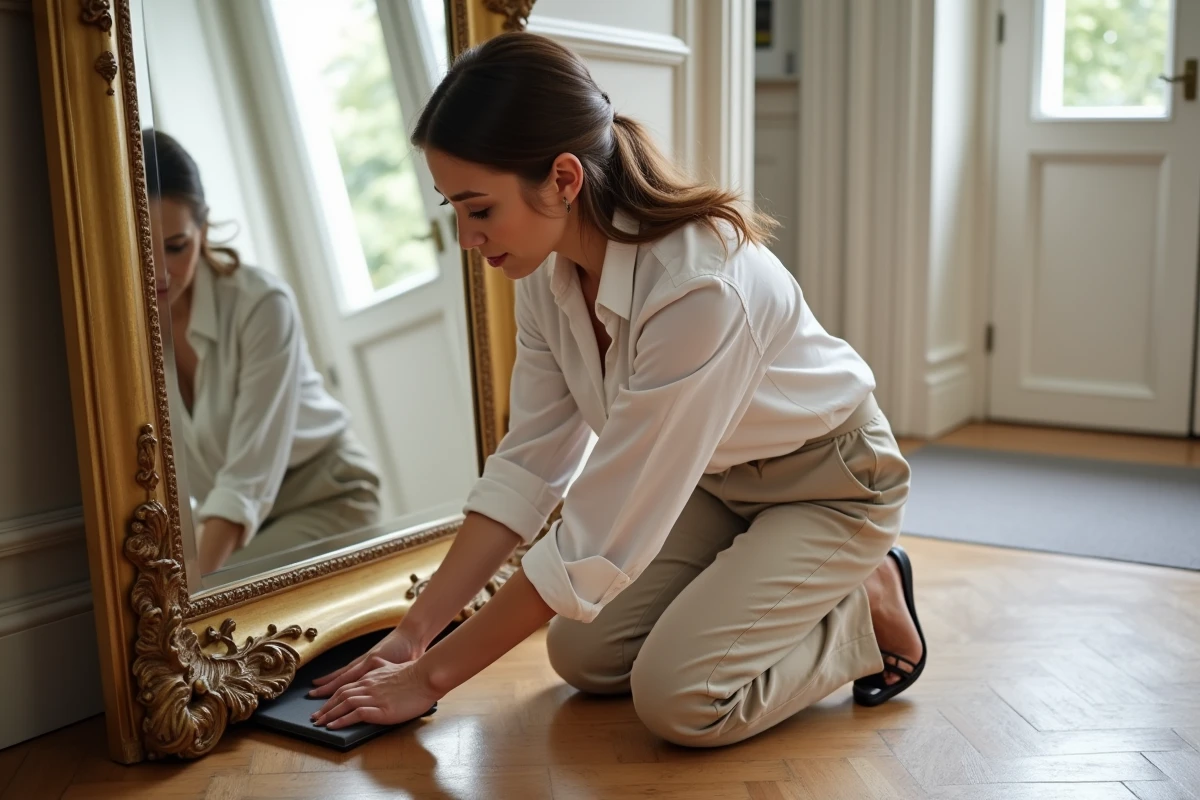
Angle of inclination and positioning of the mirror against a wall
In an apartment, the ideal angle depends on the height of the mirror and the desired use. A large mirror placed too tilted exerts significant pressure forward at the base, increasing the risk of sliding.
Reducing the inclination to about ten degrees is enough to obtain a full-length reflection while keeping the base stable. To check the angle, place a phone with a level app on the frame.
The positioning in the room also matters. A mirror placed opposite a window reflects natural light and visually enlarges a narrow hallway or entrance. Positioned in a corner of the wall, the frame benefits from two support surfaces, which improves stability without any additional accessories.
Furniture or console as a natural stop
Pressing the base of the mirror against a low piece of furniture (console, dresser, entry bench) adds a physical stop that the mirror cannot surpass. The weight of the furniture prevents forward sliding. This configuration works particularly well in an entryway or hallway, where the mirror and the furniture together form a decorative focal point.
The stability of a standing mirror without fixation always relies on the same principle: block the base and restrain the top. Whether the mirror is in a living room, a furnished rental, or a van heading south, the combination of a low wedge, suitable pad for the floor, and high restraint covers most situations.
The only point on which field feedback diverges is the durability of adhesives depending on the nature of the wall, which justifies a discreet test before any permanent installation.