Squats, push-ups, planks: everyone mentions them, and everyone piles them on. The real key to a full-body strength program isn’t the list of exercises, but how they work together to cover the three fundamental movement patterns (pushing, pulling, and stabilizing) without creating imbalances.
Push-pull-stabilization ratio: structuring a strength-training session
A program that strings together squats, push-ups, lunges, and mountain climbers without a single pulling movement overloads the anterior chain. The shoulders roll forward, the thoracic spine stiffens, and progress stalls.
To balance a bodyweight workout, we recommend aiming for a ratio close to 1:1 between pushing movements (push-ups, dips) and pulling movements (pull-ups, inverted rows). Stabilization exercises (planks, Pallof presses) round out each block.
This framework helps you choose the main fitness exercises based on their mechanical function rather than isolated muscle groups.
- Horizontal and vertical pushing: standard push-ups and pike push-ups to target the shoulders in a vertical plane
- Horizontal and vertical pulling: inverted rows under a low bar or sturdy table, overhand or underhand pull-ups
- Axial and rotational stabilization: front plank, side plank, dead bug for anti-extension control of the lower back
Squats and push-ups: proper technique and common mistakes
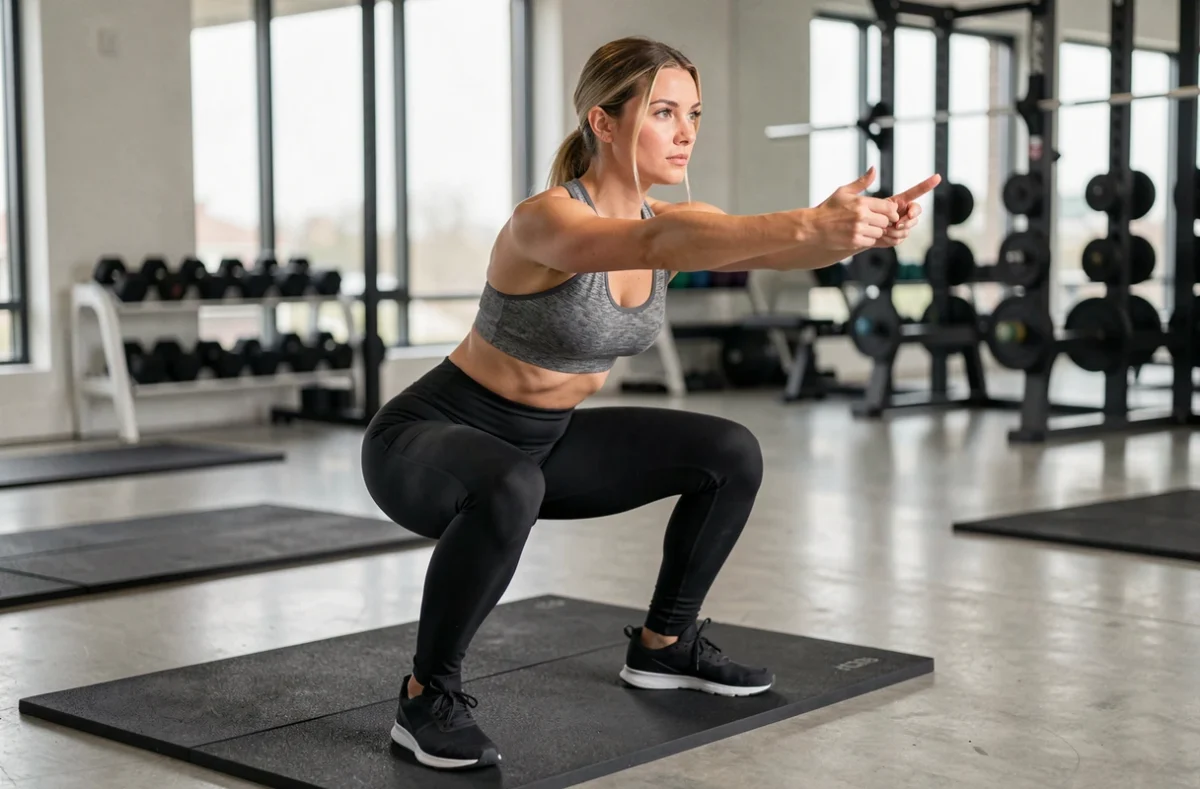
The bodyweight squat remains a cornerstone of lower-body training. The often-repeated cue (“lower yourself as if sitting down”) overlooks a critical point: how your weight is distributed between the balls of your feet and your heels. If your heels lift, your quads take over from your glutes and stress on the knees increases.
Stand with your feet slightly wider than shoulder-width apart and your toes turned outward. Initiate the descent by moving your hips back. Keep your gaze level. Push through your heels to stand, squeezing your glutes at the top of the movement.
Push-ups: hand position and range of motion
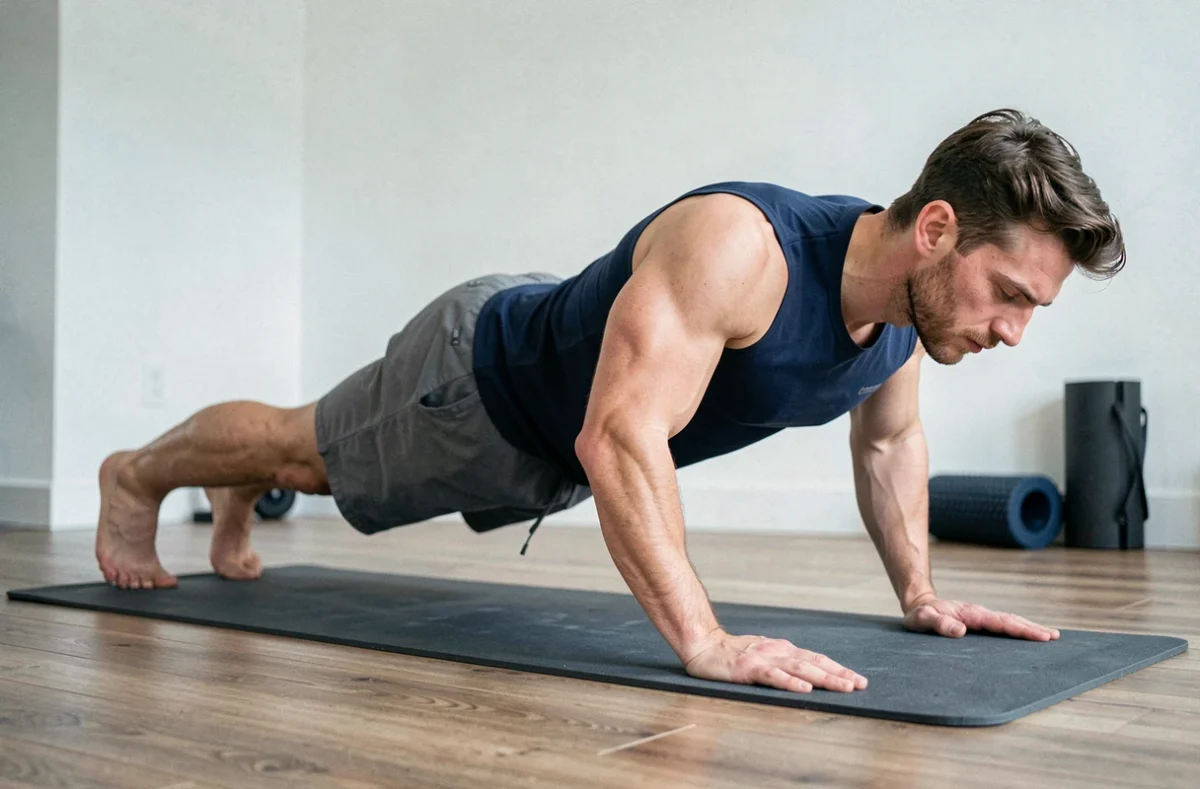
The most common push-up mistake isn’t hand placement—it’s cutting the movement short. Lowering until your chest nearly touches the floor works your pecs through their full range of motion. A half push-up targets the triceps and front deltoids, not the pectoralis major.
Place your hands slightly wider than shoulder-width apart, with your elbows angled about 45 degrees from your torso. Your body should form a straight line from your ankles to the crown of your head, without sagging at the lower back or hips.
Planks and dead bugs: strengthen your core without spinal flexion
Crunches remain popular, but repeatedly flexing the spine under load isn’t the most functional way to protect your back. Isometric planks and anti-extension exercises transfer better to everyday movements and other fitness exercises.
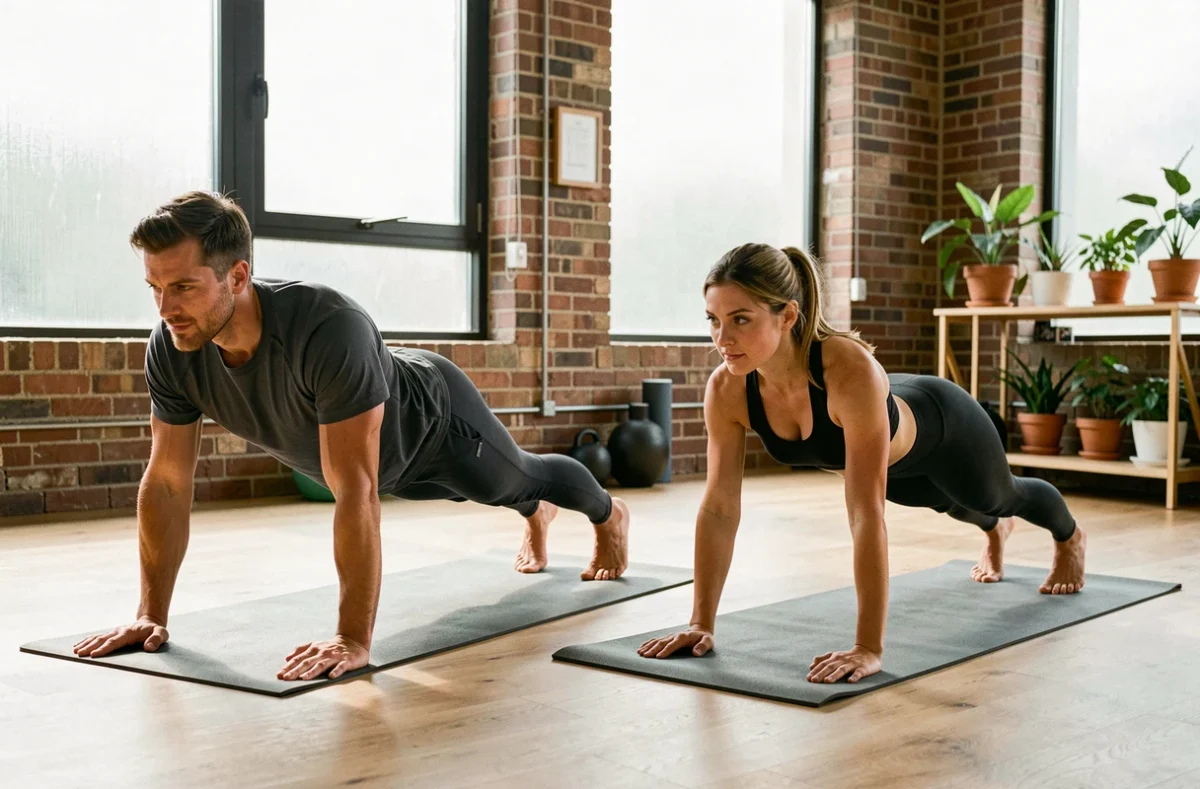
The forearm plank targets the abs, obliques, and deep core stabilizers. How long you hold it matters less than maintaining good form: slightly tuck your pelvis, and avoid arching your lower back.
Dead bugs for motor control
Lie on your back with your arms extended toward the ceiling and your knees bent at 90 degrees. Extend one arm and the opposite leg at the same time, without letting your lower back lift off the floor. This exercise trains you to move your limbs independently of your torso—a useful movement pattern for running, cycling, and most team sports.
Dead bugs are a better alternative to supermans for people with excessive lumbar curvature, as they strengthen the deep abs while teaching the nervous system to stabilize the lower back.
Frequency and progression: what current guidelines say
The WHO recommends working the major muscle groups at least two days a week. A summary of the ACSM guidelines published in 2026 notes that training to muscular failure does not consistently offer an advantage for healthy adults. It’s better to leave one or two reps in reserve and focus on consistency.
Machines, free weights, or bodyweight exercises: no type of equipment has proven superior to the others for building strength. The choice depends on individual preferences and the ability to stick with a routine over time.
Progressing without equipment
Progressive overload with bodyweight exercises comes down to three strategies:
- Increase the range of motion (elevate your feet on a step for push-ups, or do Bulgarian split squats instead of regular squats)
- Reduce your base of support (one-arm push-ups, pistol squats assisted with a strap)
- Slow down the eccentric phase (take four seconds to lower into a squat or push-up) to increase time under tension
These adjustments are enough to keep you progressing for several months before adding external weight becomes worthwhile.
Strength training and sedentary behavior: a workout can’t make up for everything
The WHO distinguishes strength training from endurance activities. Two strength-training sessions a week don’t make up for spending the day sitting. Santé Magazine points out that there’s no formula for undoing the effects of prolonged sedentary behavior with a single workout.
Combining strength exercises with regular periods of walking or active mobility throughout the day remains the most well-rounded strategy for overall health. A complete fitness program includes strength and stabilization exercises, along with enough aerobic activity spread throughout the week.